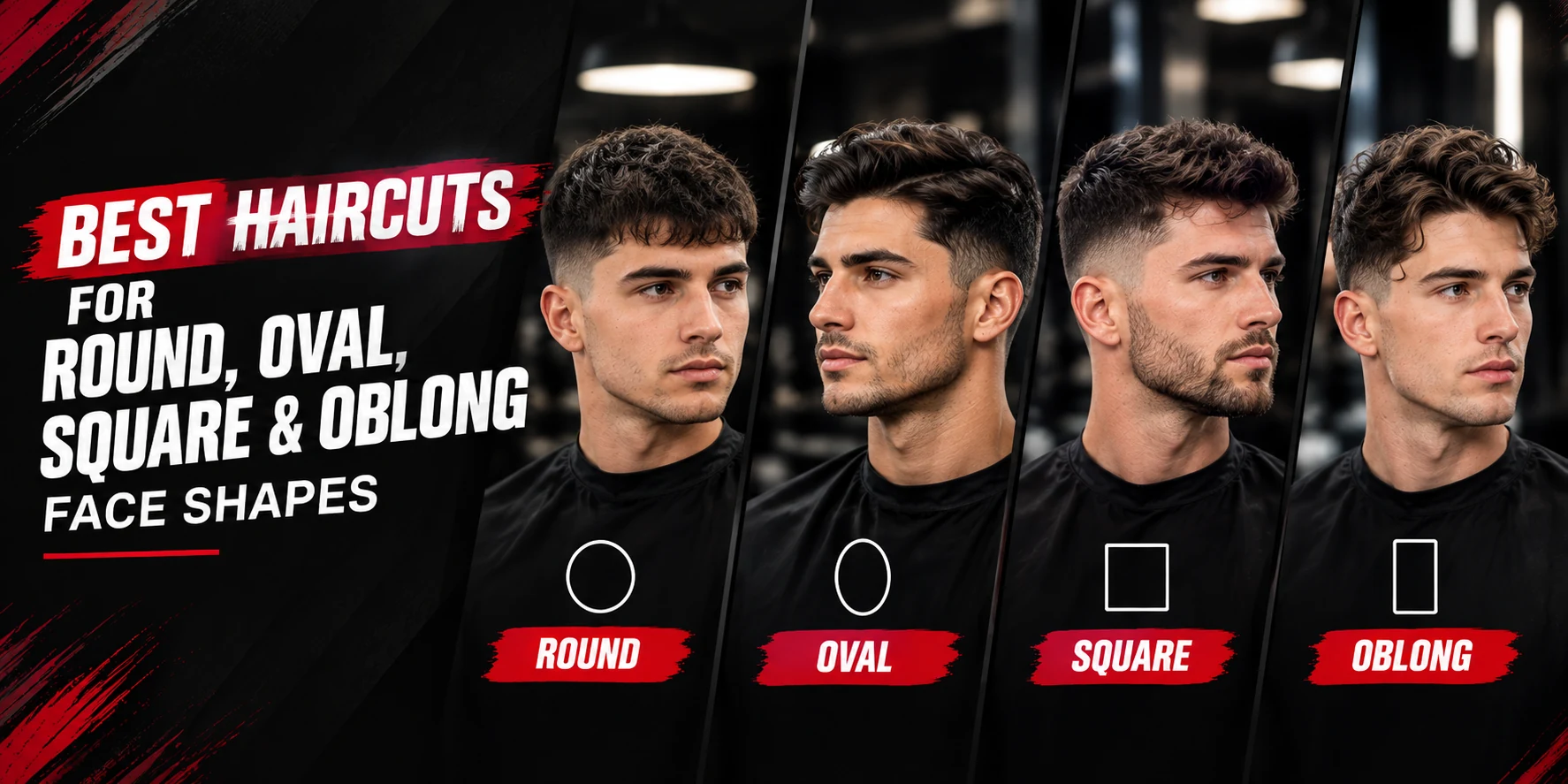
Best Haircuts for Round, Oval, Square & Oblong Face Shapes
You show your barber a photo. The cut looks perfect on the model. On you, it looks a little off.
That’s rarely a skill issue. It’s usually a face shape issue.
Your face shape tells you where a haircut should add height, where it should add width, and where it should stay tight. Match those three things and almost any cut looks sharper.
This guide covers Round Haircuts, Oval Haircuts, Square Haircuts, and what works for Oblong Face Shapes. Inside you’ll find:
- A 60-second way to find your face shape
- The best cuts for each shape
- What to avoid
- The exact words to say in the barber chair
It works whether you’re 13 and booking your first real barbershop cut, or 40 and tired of the same old style.
How to Find Your Face Shape in 60 Seconds
Your face shape comes from how wide your forehead, cheekbones, and jaw are compared with your face length.
Here’s the quick method:
- Pull your hair back off your forehead.
- Stand in front of a mirror in good light.
- Check which part of your face is widest: forehead, cheekbones, or jaw.
- Compare your face length (hairline to chin) with the width across your cheekbones.
- Match what you see to the table below.
Face shape | What to look for | Widest point |
Round | Length and width almost equal, soft jaw | Cheeks |
Oval | Slightly longer than wide, rounded jaw | Cheekbones |
Square | Length and width close, strong flat jaw | Jaw and forehead |
Oblong | Clearly longer than wide, straight sides | Even from top to bottom |
Between two shapes? Go with the one that matches your jaw. A barber can confirm it in about ten seconds.
Still growing? Teen faces change. Recheck once a year.
Best Round Haircuts for Men and Boys
Round Haircuts have one job: make your face look longer and more defined.
A round face has soft curves, and its width and length are close to equal. So the goal is height and angles.
Best cuts for a round face:
- High fade with a textured top
- Pompadour
- Quiff
- Faux hawk
- Side part with a skin fade
Why they work: Tight sides slim the width. Volume on top adds length. Together they stretch the face.
Skip these:
- Full, bulky sides that add width
- A very short, flat top
- A heavy straight fringe that cuts across the face
Say this to your barber: “High fade, keep the length on top, and add texture.”
Hair type tip: Curly or coarse hair already has natural lift. Round Haircuts built on that volume need less time to style.
Best Oval Haircuts: The Most Flexible Face Shape
Oval Haircuts are the easiest to choose because the proportions are already balanced. Your goal is to keep that balance, not fix anything.
Best cuts for an oval face:
- Crew cut
- Textured crop
- Side part taper
- Undercut
- Pompadour
- Slick back
Skip these:
- Flat, no-volume styles. They can make an oval face look longer than it is.
Flexible doesn’t mean anything goes. Your hair density and growth pattern still decide the result. A cowlick at the front will fight a slick back, whatever your face shape.
Beard pairing: Clean-shaven or a short beard both work. A heavy, long beard throws off the balance.
Good Oval Haircuts come down to one question: what fits your hair and your daily routine?
Best Square Haircuts: Soften or Sharpen Your Jawline
Square Haircuts follow one of two paths. Pick the one that matches the look you want.
A square face has a strong, flat jaw and a forehead that’s about as wide.
Path 1: Soften the angles
- Textured comb over
- Side-swept fringe
- Curtain hair
- Loose, relaxed quiff
Path 2: Sharpen the angles
- Buzz cut
- Crew cut
- French crop
- High fade
Avoid: Boxy, blunt lines. They stack more squareness on top of the jaw you already have.
Say this to your barber: “Keep the corners soft,” or “Square it off clean.” Either one gives them clear direction.
Beard pairing: Stubble or a short, shaped beard keeps the jaw defined without adding bulk.
Best Haircuts for Oblong Face Shapes
Oblong Face Shapes are longer than they are wide, with fairly straight sides. The goal is to cut height on top and add width at the sides.
Best cuts:
- French crop
- Caesar cut
- Side part with texture
- Short, side-swept styles
- Medium length with some side volume
Avoid:
- Tall, upright tops
- Tight, shaved sides that stretch the face
- Long, flat, straight styles that pull everything down
The fringe question. Advice online clashes on this. Here’s the simple version:
- A short, horizontal fringe (like a French crop) helps. It shortens the face.
- A long, heavy fringe doesn’t. It just hides your forehead.
Beard pairing: Short beards or full stubble. A long beard adds even more length.
Face Shape Cheat Sheet
Screenshot this one before your next appointment.
Shape | Goal | Best cuts | Skip |
Round Haircuts | Add height and angles | High fade with textured top, quiff | Full sides, flat top |
Oval Haircuts | Keep the balance | Crew cut, textured crop, side part | Flat, no-volume styles |
Square Haircuts | Soften or sharpen | Textured comb over, French crop | Boxy, blunt lines |
Oblong Face Shapes | Add width, cut height | French crop, Caesar, side part | Tall tops, tight sides |
Hair Texture and Thickness Change the Result
Face shape sets the direction. Hair texture decides how the cut turns out.
- Straight hair: Holds sharp lines well. Fades and crops look clean.
- Wavy hair: Adds natural texture. Great for quiffs and textured crops.
- Curly hair: Gives volume with little effort. Ask for a taper to keep the sides neat.
- Thick hair: Needs thinning or a taper so it doesn’t sit like a helmet.
- Thin or receding hair: Textured crops and shorter lengths hide it better than slick styles.
Two people with the same face shape can need different cuts. Tell your barber your hair type before the clippers come out.
How to Ask Your Barber for the Right Cut
Walking in and saying “just a trim” gets you a guess. A clear request gets you a result.
Use this four-part formula:
- Shape: “I think I have a round face,” or whatever you found above.
- Sides: “Taper,” “mid fade,” or “high fade.”
- Top: “Long enough to style,” or “short and textured.”
- Routine: “I have five minutes in the morning.”
More tips that help:
- Bring two or three photos, ideally of hair like yours.
- Mention a school or work dress code up front.
- Ask, “What would you change about this photo for my face?”
At MVP Modern Barbers, you can browse the MVP Lookbook before you visit and use digital check-in to get started. MVP also offers extras like a scalp massage and a hot towel finish.
Styling Basics and Products
A great cut falls flat if the styling is wrong. Keep it simple.
Products worth knowing:
- Matte clay: Adds volume with low shine. Good for textured crops and quiffs.
- Texture paste: Separates strands for a messy, lived-in finish.
- Shave cream: Keeps fades, neck lines, and beards clean at home.
A 3-step routine:
- Towel dry your hair until it’s damp, not dripping.
- Warm a pea-sized amount of product in your palms.
- Shape with your fingers or a comb, working from the front back.
You can find these in the MVP online shop.
Common Face Shape Haircut Mistakes
- Copying a celebrity cut. Check the face shape first. Same hair on a different face gives a different result.
- Ignoring your growth pattern. Cowlicks and crowns change how hair sits.
- Fading too high on a narrow face. It can make the face look longer.
- Skipping trims. Fades grow out in two to three weeks, so book your next visit before you leave.
Final Thoughts
You don’t need to memorize every cut. Remember one rule per shape:
- Round Haircuts: add height, keep the sides tight.
- Oval Haircuts: protect the balance and pick what suits your hair.
- Square Haircuts: decide whether to soften or sharpen the jaw.
- Oblong Face Shapes: reduce height, add width.
Then bring clear words and a few photos to your barber.
Ready to try a new cut? Book with an MVP stylist at your nearest location in Toronto, Halifax, Saskatoon, Moncton, or Fort McMurray. Or browse the MVP Lookbook first to find your next look.
FAQ:
What are the best Round Haircuts?
A high fade with a textured top, a quiff, a pompadour, or a faux hawk. All of them keep the sides tight and add height on top, which makes a round face look longer and sharper.
Do Oval Haircuts work for every hair type?
Most do, because an oval face is balanced. Hair type still matters, though. Straight hair suits slick styles, while curly hair looks best in textured crops and tapers.
What haircut suits a square jaw?
Both soft and sharp options work. A textured comb over softens the jaw. A crew cut or French crop sharpens it. Square Haircuts depend on the look you want.
Should I get a fringe with Oblong Face Shapes?
A short, horizontal fringe like a French crop can help by shortening the face. Avoid a long, heavy fringe. Oblong Face Shapes need less height and more width.
What if my face is between two shapes?
Choose the cut for the shape that matches your jaw. Your barber can confirm it during the consultation.
How often should I trim a fade?
Every two to three weeks it keeps a fade clean. A longer taper or crop can usually go four to six weeks.
Can a haircut make my face look thinner?
Yes, to a degree. Height on top and tight sides make a face look longer and slimmer. That’s the idea behind most Round Haircuts.