Low Fade vs Mid Fade vs High Fade: Which to Get?
You sit down in the barber’s chair. “What are we doing today?” You say, “A fade.” Then comes the question you weren’t ready for: “Low, mid or high?”
Most people freeze and mumble, “Uh, whatever looks good.” That’s how you end up with a cut that’s too short, too bold, or just not you.
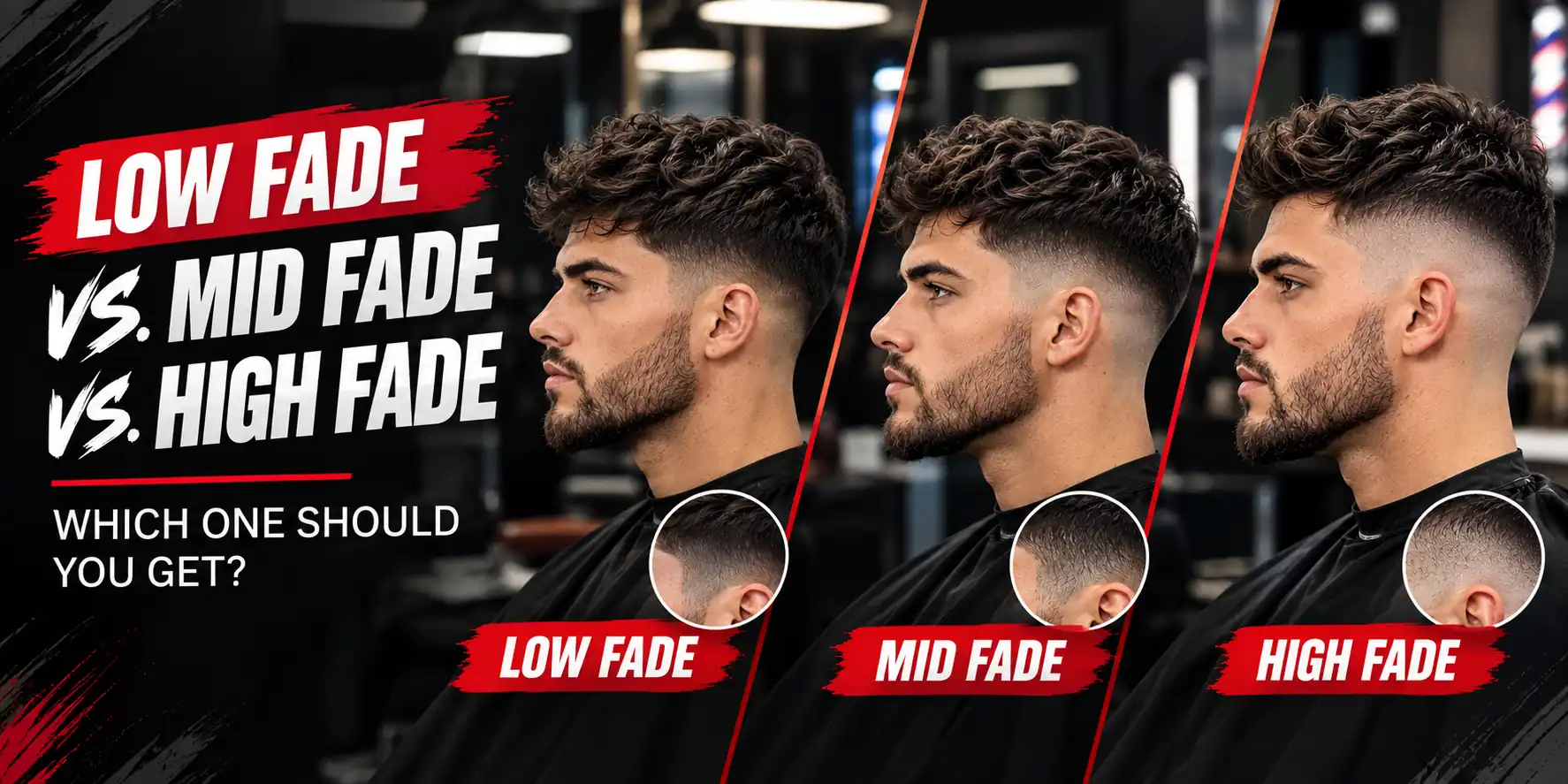
The good news is that low fade vs mid fade vs high fade is simpler than it sounds. It comes down to one thing: where the fade starts on your head.
- Low fade: starts just above the ear. Subtle and easy to live with.
- Mid fade: starts around the temple. Balanced, with noticeable contrast.
- High fade: starts at or above the temple. Bold, sharp and high contrast.
Below, we’ll cover each cut, taper vs fade, zero vs skin, face shapes, upkeep, and what to say to your barber.
Low Fade vs. Mid Fade vs. High Fade: Quick Comparison
Height is the main difference. How bold the cut looks and how often you need a touch-up both follow from it.
| Low Fade | Mid Fade | High Fade | |
| Starts at | Just above the ear | Around the temple | At or above the temple |
| Look | Subtle, clean | Balanced, modern | Bold, sharp |
| Contrast | Low | Medium | High |
| Often chosen for | First-timers, school, office | A balanced look with many hairstyles | Bold styles, volume on top |
| Touch-up | About every 3–4 weeks | About every 2–3 weeks | About every 1–2 weeks |
| Risk level | Very safe | Safe | Makes a statement |
Not sure which one to pick? A mid fade gives you a balanced starting point between a low and a high fade.
What Is a Fade Haircut?
A fade makes the hair on the sides and back gradually shorter as it moves down. It blends from longer hair into very short hair, or all the way to skin. There’s no hard line, just a smooth gradient.
A few words your barber might use:
- Guard: the plastic clipper attachment that sets the hair length.
- Blend: the smooth transition between two lengths.
- Line-up: the crisp edge along your hairline.
- Skin fade: a fade that goes down to bare skin.
What Is a Low Fade? (Lower Fade Haircut for Men)
A low fade starts just above the ear and curves down toward the neckline. The sides keep most of their length, and only the bottom edge fades.
That’s why the lower fade haircut for men is a popular first fade. It looks neat without shouting.
A low fade is a good fit if you:
- Want your very first fade
- Have a school or office dress code
- Wear a beard or stubble, since it blends in naturally
- Want to go longer between cuts
Pros:
- Easy upkeep
- Looks professional in most settings
- Grows out gently
Cons:
- Less contrast, so your top has to carry the style
- Can feel too plain if you want something dramatic
What Is a Mid Fade? (Medium Fade Hairstyles)
A mid fade starts around the temple, halfway between a low and a high fade. You see more short hair than with a low fade, but less than with a high one.
It offers a balanced amount of contrast and can work well with many face shapes and hairstyles. Medium fade hairstyles pair with a crop, a quiff, curls or a side part.
A mid fade is a good fit if you:
- Want a clear, modern look
- Can’t decide between low and high
- Have a beard, since a mid fade transitions into it cleanly
- Need one cut that works at school, at work and on weekends
The downside: you’ll want a touch-up a little sooner than with a low fade.
What Is a High Fade?
A high fade starts at or above the temple. The sides look very tight, and your top stands out more.
A high fade is a good fit if you:
- Want a bold, sharp look
- Have volume or length on top
- Like strong contrast, especially with a skin finish
- Want a clean, sporty style
Real talk: a week of growth shows fast on a high fade. If you hate frequent barber visits, this may not be your cut. Also check your school or workplace rules first, since some find it too bold.
Mid Fade vs. Low Fade: Which One Looks Better on You?
Mid fade vs low fade is a question barbers hear often. Both look clean. The difference is how much of the sides you show.
Pick a low fade if:
- You want subtle and understated
- Your dress code is conservative
- You’re growing a fade out slowly
- You have a longer top or a side part
Pick a mid fade if:
- You want a modern look with visible contrast
- You have an oval or square face
- You wear a beard
- You want a balanced look with more contrast than a low fade
A simple test: if you want people to think “nice haircut,” go low. If you want them to notice you got a fresh cut, go mid.
Low Fade vs. High Fade: Subtle or Statement?
Low fade vs high fade is the biggest jump of the three. One is quiet and the other is loud.
- Height: ear level vs temple level and above
- Sides: a low fade keeps width, while a high fade removes it
- Face effect: a high fade adds visual height, and a low fade keeps things wider
- Upkeep: a low fade lasts longer between cuts
- Setting: a low fade fits nearly anywhere, while a high fade needs more thought
If you have a long or narrow face, be careful with a high fade plus a tall top, because that stacks up a lot of height. A low or mid fade usually looks more balanced.
Low vs. Mid Taper: What’s the Difference?
Low vs mid taper follows the same height logic as fades. First, though, you need to know taper vs fade.
- Taper: the hair gets shorter gradually but stays short and visible at the bottom. It’s usually around the sideburns and neckline.
- Fade: the hair blends down to skin or close to zero.
Now the heights:
- Low taper: starts just above the ear and neckline. Very subtle.
- Mid taper: starts higher, around the temple or mid-ear. A little more noticeable.
Rule of thumb: want the softest, most natural grow-out? Choose a taper. Want sharp contrast? Choose a fade. If you can’t visit your barber often, a taper is the friendlier option.
Zero Fade vs. Skin Fade: How Low Should It Go?
Zero fade vs skin fade confuses people because not every barber uses the words the same way.
The most common meaning:
- Zero fade: done with clippers on the zero setting (no guard). The hair is super short, but a faint shadow remains.
- Skin fade (bald fade): goes all the way to bare skin, usually finished with a foil shaver or razor.
Some barbers treat the two as the same cut. To avoid the guessing game, tell your barber exactly what you want, like “zero guard, no foil” or “take it to bare skin.”
Both can be low, mid or high. You can ask for a “low skin fade” or a “mid zero fade.”
Upkeep: a skin fade shows regrowth fastest. A zero fade is a bit more forgiving.
How to Choose the Right Fade for You
Forget trends for a minute. Four things matter most: face shape, hair type, lifestyle and upkeep.
1. Face shape
Face shape isn’t an exact science, but these are common starting points:
| Face shape | Fade to consider | Why it can work |
| Round | Mid or high | Can add visual height and contrast |
| Square | Low or mid | Can balance the stronger jawline |
| Oval | Any | Generally works with many fade heights |
| Long / rectangular | Low or mid | Can avoid adding too much visual height |
| Heart | Low or mid | Can create a softer transition around the temples |
2. Hair type
- Thick or curly: any height can work. A mid fade keeps your shape and texture.
- Fine or thin: go softer, with a low fade or a low to mid taper, so the sides don’t look sparse.
- Straight: any height works. Choose based on your face and how much contrast you like.
3. Lifestyle
- School: low or mid. Check your dress code first.
- Office: low or mid.
- Sports: any height. Shorter sides feel cooler and cleaner.
- Weddings and events: a low or mid fade, booked a few days ahead so the cut settles.
4. Upkeep
Ask yourself honestly how often you’ll visit.
- Every 1–2 weeks: a high fade is fine.
- Every 2–3 weeks: a mid fade works.
- Every 3–4 weeks or longer: go low.
Hair grows at different speeds, so treat these as a guide and not a rule. If you want your fade to stay sharp between appointments, see our guide to fade haircut maintenance between barber visits.
Low Fade vs. Mid Fade vs. High Fade FAQs
What is the difference between a low fade, mid fade and high fade?
Where the fade begins. A low fade starts just above the ear, a mid fade at the temple, and a high fade at or above the temple.
Is a mid fade or low fade better?
Neither is better. A low fade is subtler and lasts longer, while a mid fade is more balanced and has more contrast.
Which fade looks best on a round face?
A mid or high fade can create more visual height, especially when paired with some length or volume on top.
How often should I get a fade?
Roughly every 1–2 weeks for a high fade, 2–3 weeks for a mid fade and 3–4 weeks for a low fade. See our fade maintenance guide for tips between visits.
What is the difference between a zero fade and a skin fade?
A zero fade uses a zero-guard clipper and leaves a faint shadow of hair. A skin fade goes to bare skin. Some barbers use the terms interchangeably, so be specific.
What is the difference between a low taper and a mid taper?
Both keep short, visible hair at the bottom. A low taper starts just above the ear, and a mid taper starts higher, around the temple.
Is a fade okay for school or work?
Usually, yes. A low or mid fade is the safest choice. Check your dress code before going higher.
Which fade is best for a first-timer?
A low fade. It’s subtle, easy to manage and forgiving as it grows out.
Which Fade Should You Get?
Here’s the short version of low fade vs mid fade vs high fade:
- Choose low if you want a subtle, lower-maintenance look.
- Choose mid if you want a balanced look with noticeable contrast.
- Choose high if you want a sharper, higher-contrast style and don’t mind more frequent touch-ups.