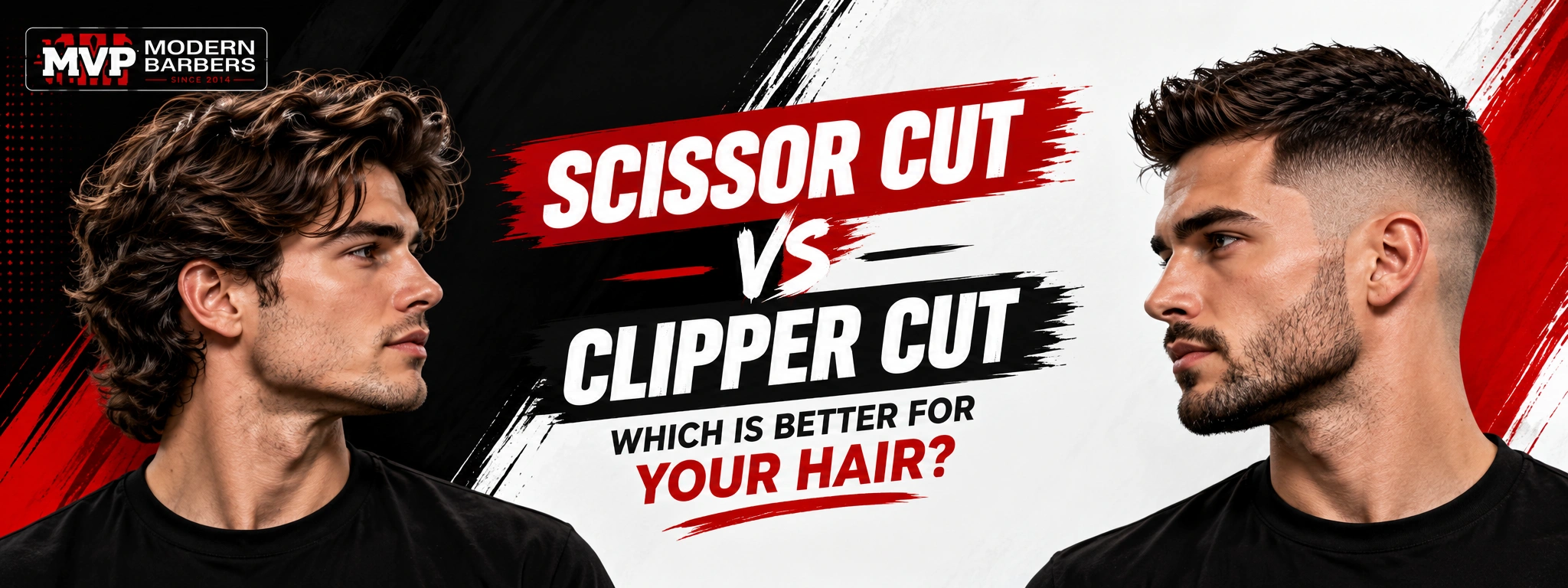
Scissor Cut vs Clipper Cut: Which Is Better for Your Hair?
Quick answer: Neither tool wins outright. Clippers cut hair fast and even, making them the go-to for fades, buzz cuts, and short styles. Scissors shape and blend hair by hand, making them the better choice for length, layers, and natural texture. The real question isn’t “Which tool is better?” It’s “Which tool matches your hair and the look you want?”
If you’ve ever sat in a barber chair and heard “number 2 on the sides, scissors on top?” you’ve already brushed up against this debate without realising it. Most people ask about clippers vs. scissors like it’s a boxing match, when in reality, most great haircuts use both. This guide breaks down exactly what each tool does, when to ask for one over the other, and how to actually communicate what you want next time you’re in the chair. We put this together with input from the stylists at MVP Modern Barbers, who cut with both tools daily across our shops.
What Is a Scissor Cut?
A scissor cut is exactly what it sounds like: a haircut done mostly (or entirely) with shears instead of an electric clipper.
Here’s what makes it different:
- The barber works in small sections, cutting hair strand by strand
- It relies on hand precision, not a motor
- It’s built for control over length, layers, and how the hair moves
- It works on every hair type, but really shines on longer or textured styles
Because each section is cut by hand, a scissor cut is more customizable. Two people with a “scissor cut” can walk out looking completely different, depending on how the barber layers and shapes the hair.
What Is a Clipper Cut? (Clipper Cut Meaning)
A clipper cut is a haircut done primarily with electric clippers, the motorized tool barbers use with interchangeable guard sizes to control length.
That’s the clipper cut meaning in the simplest terms: speed and consistency, powered by a machine instead of a hand tool.
Clipper guards are numbered, and the numbers are fairly universal across brands:
Guard Number | Approx. Length | Common Use |
0 | 1/16 inch | Skin fade, bald look |
1 | 1/8 inch | Buzz cut |
2 | 1/4 inch | Short crew cut |
3 | 3/8 inch | Classic short cut |
4 | 1/2 inch | Slightly longer top |
5+ | 5/8 inch+ | Blended, longer sides |
Clipper cuts are the backbone of fades, buzz cuts, crew cuts, and tapers any style where you need hair to be short, even, and consistent across the whole head.
Scissor Cut vs Clipper Cut: Key Differences at a Glance
This table is the fastest way to see the scissor vs clipper cut comparison side by side.
Factor | Scissor Cut | Clipper Cut |
Technique | Hand-cut, section by section | Machine-cut with guards |
Best for | Length, layers, texture | Fades, buzz cuts, short styles |
Precision | High, customized per section | High, but uniform across sections |
Speed | Slower | Faster |
Regrowth look | Soft, grows out naturally | Can look “porcupine-like” as it grows |
Cost per visit | Usually higher | Usually lower |
Visit frequency | Every 6–8 weeks | Every 2–3 weeks |
Skill level needed | Very high | High, especially for fades |
Neither column is objectively “better” they’re built for different jobs. A scissor cut vs clipper cut decision really comes down to what you want your hair to look like in three weeks, not just today.
Clippers vs Scissors: Pros and Cons
Scissor Cut Pros and Cons
Pros:
- Creates natural movement and softer lines
- Blends different lengths and textures seamlessly
- Grows out gracefully with no harsh regrowth line
- Works on virtually every hair type
- Lets you keep length while still shaping the cut
Cons:
- Takes longer in the chair
- Usually costs more per appointment
- Requires a highly skilled barber to get consistent results
- Not ideal if you want a very short, uniform look
Clipper Cut Pros and Cons
Pros:
- Fast most clipper cuts take a fraction of the time
- Delivers clean, uniform length across the head
- Great for sharp fades and crisp outlines
- Lower cost per visit
- Low daily maintenance once cut
Cons:
- Grows out faster and can look uneven within a couple weeks
- Less versatile for longer or heavily textured styles
- Can feel harsher on the hair with repeated close cutting
- Limited ability to create soft, blended layers on its own
Cutting Hair with Scissors vs Clippers by Hair Type
Your hair type changes which tool is going to give you the better result. Here’s a fast breakdown.
Straight or fine hair
Clippers tend to work well here because there’s less texture to fight with, and guard numbers give you predictable, even results. Scissors are still useful for softening the top or adding light layers.
Thick or coarse hair
This is where clippers really earn their keep they cut through volume quickly and evenly. Scissors get added on top for blending and weight removal so the cut doesn’t sit too heavy.
Curly or textured hair
Scissors usually win here. Curls behave differently strand by strand, so hand-cutting lets the barber shape around the natural pattern instead of flattening it into one uniform length. Clippers are still used for tight fades on the sides, but the top usually needs scissor work.
The takeaway: cutting hair with scissors vs clippers isn’t about picking a “winning” tool for your hair type it’s about knowing which tool handles which part of the job.
Scissor Cut vs Razor Cut Is That the Same Thing?
Quick clarification, because these two get mixed up a lot: a scissor cut vs razor cut comparison is actually a different conversation than scissors vs clippers.
- A scissor cut uses shears to cut hair to length and shape it in sections.
- A razor cut uses a straight razor to slice through the ends of the hair, creating extra texture and a softer, feathered finish.
Some barbers combine razor work with a scissor cut to add texture without cutting length. But a razor cut is a texturising technique, not a length-cutting one it’s not really a competitor to clippers the way scissors are.
When Should You Choose a Scissor Cut?
Go with scissors if:
- You’re growing your hair out and don’t want to lose length
- You want layers, texture, or a face-framing shape
- Your hair is curly, wavy, or thick and needs section-by-section handling
- You want your cut to grow out softly instead of looking blocky after two weeks
- You’re after a more polished, professional look
When Should You Choose a Clipper Cut?
Go with clippers if:
- You want a fade, taper, buzz cut, or crew cut
- Low daily maintenance matters more than styling versatility
- You run warmer and prefer shorter hair
- You want sharp, defined lines around the neckline and edges
- You’re comfortable visiting the barber more often to keep the shape fresh
Can You Combine Scissors and Clippers? (Hybrid Cuts)
Here’s the part most articles on this topic skip: the majority of modern barbershop haircuts aren’t purely one or the other.
A typical hybrid cut looks like this:
- Clippers create the fade or taper on the sides and back
- A guard-length is set to blend into the top
- Scissors take over on top to shape, layer, and add texture
- A razor may finish the edges for extra softness
This combo gives you the best of both: clean, defined sides from the clippers, and natural movement on top from the scissors. At MVP Modern Barbers, this blended approach is standard our stylists build the cut around your hair type and face shape rather than defaulting to one tool for the whole head. If you’re not sure what to ask for, that’s a completely normal starting point for a consultation.
Cost and Maintenance Comparison
A quick reality check on the long-term cost of each option:
- Clipper cuts cost less per visit but need touch-ups every 2–3 weeks to stay sharp, especially fades
- Scissor cuts cost more per visit but stretch to every 6–8 weeks before they need a refresh
- Over a few months, the total cost often ends up closer than people expect — clipper cuts just spread the cost across more visits
Maintenance in between visits also differs:
- Clipper cuts benefit from scalp moisturizer, especially with very short guard lengths
- Scissor cuts hold their shape longer with a light leave-in product and regular brushing to keep layers looking intentional
Frequently Asked Questions
Is a scissor cut better than a clipper cut?
Neither is universally better. Scissor cuts are better for length, layers, and texture. Clipper cuts are better for short, uniform styles like fades and buzz cuts. The right choice depends on your hair type and how low-maintenance you want your routine to be.
What does clipper cut mean compared to a scissor cut?
A clipper cut means the haircut was done mainly with electric clippers and guard attachments for even length. A scissor cut means it was done mainly by hand with shears for shaping and texture.
Do barbers use both scissors and clippers in one haircut?
Yes, very often. Most modern cuts use clippers for the sides and back, then scissors on top to blend and add texture this is sometimes called a hybrid or blended cut.
Is a scissor cut vs razor cut the same technique?
No. Scissors cut hair to length in sections, while a razor slices the ends for extra texture. A razor is often used alongside a scissor cut, not instead of one.
Which lasts longer, a scissor cut or a clipper cut?
Scissor cuts generally last longer between appointments often 6 to 8 weeks because the softer, layered finish grows out more naturally. Clipper cuts usually need a refresh every 2 to 3 weeks to keep clean lines.
Is a scissor cut more expensive than a clipper cut?
Per visit, yes scissor cuts typically cost more due to the time and skill involved. But since clipper cuts require more frequent visits, the overall cost over a few months can end up similar.